


Phil
Pennington Reporter
NZ
Police has cut some back office jobs – but not the roles
that leaders said might be taken over by AI.
Documents
show their Transcription Services team has feared that their
jobs are at risk since 2024.
RNZ can now reveal police
cut two dozen jobs in their file management unit last month,
in a restructure in which more than 60 positions were
disestablished, created or shifted.
Transcription
Services has been largely spared from the job cuts, but is
now subject to its own modernisation programme.
Its
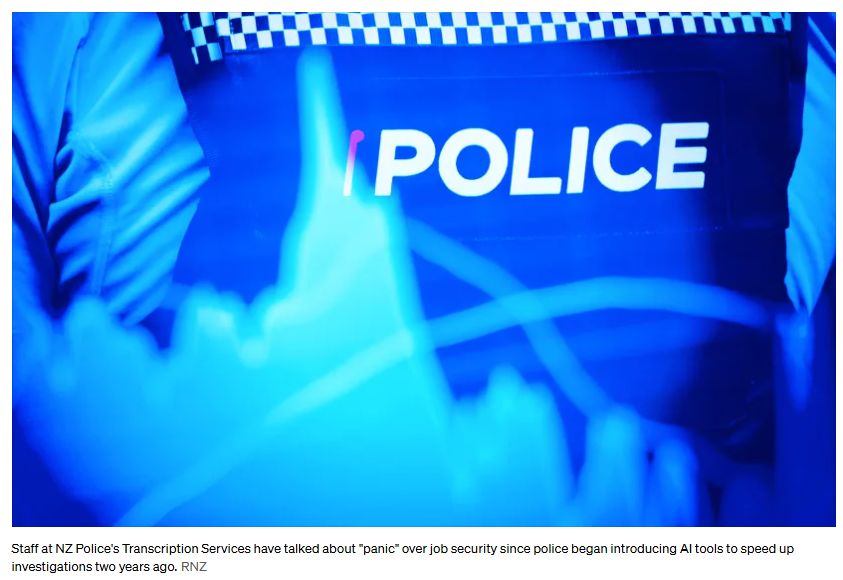
staff have talked about “panic” over job security since
police began introducing AI tools to speed up investigations
two years ago.
The manager of intercept and technology
operations acknowledged this in March last year. “There was
a recognition that automating English transcription could
affect positions traditionally responsible for this work,”
said Stuart Mills in a report.
NZ Police rolled out
another new tool from an American tech firm to transcribe
interviews on Monday.
“We appreciate there has been
some uncertainty about what the future of AI in the police
will look like,” police told RNZ on Tuesday.
People
were still needed to transcribe accurate, quality statements
– such as for court – said front-line file management and
transcription services national manager Sarah
Hutchings.
Advertisement – scroll to continue reading
“Artificial Intelligence was not a factor
of workforce reductions in this review.”
‘They will
directly influence the size’
Police released a
100-page-plus restructure document dated July to RNZ on
Tuesday. It followed consultations, and the job changes
kicked in last month.
It showed police were aiming for
a more nationally co-ordinated, flexible service that can
“leverage digital and automation efficiencies”.
“As
these technologies become fully embedded, they will directly
influence the size, structure, and skill mix of our
workforce,” the document said.
Hutching said the new
tech would achieve clearer accountability and more
efficiency.
“Those efficiencies were a result of the
review, and financial savings were made. Those savings
didn’t come at the loss of any Transcription Services
staff.”
But the modernisation programme for
Transcription Services “allows us to understand how we
better use technology to be more efficient at our jobs”, she
said in a statement.
‘May be some anxiety’
The
Police Association has about 280 members in the restructured
unit. It said AI came up in its talks with police about the
changes.
Police earlier told RNZ: “We acknowledge
there may be some anxiety from Transcription Services staff
because these tools have been approved for
use.”
Police on Monday began using new AI from
taser-maker Axon to transcribe
many interviews. They had tested translation tool
Whisper AI in mid-2024 on intercepted Chinese language
phonecalls during the Auckland cult homicide
investigation.
This year they have moved to add a
second translation-transcription tool made by Facebook
parent company Meta, as well as using new AI tools from
European law enforcement to help with child exploitation
investigations.
The PSA union said it had not been
able to establish instances of consultation with police
about the use of Whisper or any other AI transcription
tools.
‘Wider disquiet’
Police have said they
take a considered approach to adopting new tech, taking into
account operational need, risk, legal requirements and
policy considerations.
However, when Transcription
Services heard police in the regions were using Whisper in
mid-2024, they voiced job fears and contacted the Police
Association, reports and emails released to RNZ
showed.
“There was wider disquiet across Service
Group,” an internal report said.
The alarm sounded
again in early 2025 after a six-month trial of the
technology that was blighted by officers
breaking the safeguards around its
use.
“Transcription staff raised concerns about
the use of Whisper AI outside of the terms and conditions,
perceived accuracy issues with the transcript, and CJSU
[Criminal Justice Support Unit] having to take time away
from their core business to check/reformat the transcripts
produced by the tool.”
A ban was imposed on
transcribing English – and translating te reo Māori and
Pacific languages – “not driven by concerns about
technological risk, but rather by the potential impact on
specific roles”, said another report.
‘It caused
panic’
Whisper use was largely suspended for about
six months.
When the leadership moved to reintroduce
it, and to lift the ban on transcribing English, a
Transcription Services manager emailed them: “Last time this
happened, it caused a panic amongst our team and concerns
over job security.”
That prompted a senior staffer to
complain that the High Tech Crime Group had “clearly” not
done enough to alert transcription staff that Whisper was
back.
Police said they had engaged with the Police
Association before, during and after the
restructure.
Association president Steve Watt told RNZ
on Monday that police “reassured us that it was simply a
trial and that no jobs were under threat as a result of the
technology that they were introducing”.
“Obviously, as
that develops and evolves, that may change and it’s just
important that police keep us informed and up to
date.”
New Zealand’s public broadcaster, providing comprehensive NZ news and current affairs, specialist audio features and documentaries.
Radio New Zealand is a Crown entity established under the Radio New Zealand Act 1995. Radio New Zealand News are vital elements in our programming, providing impartial news and information to New Zealanders every day. Radio New Zealand (RNZ) provides listeners with exciting and independent radio programmes in accordance with the Radio New Zealand Charter.