



Will and Kim Grayling’s story is one of starting at the bottom of the New Zealand dairy industry and rapidly working their way up the ladder.
The couple, in their late 30s, are currently share-milking in a business that owns 6,500 cows across New Zealand’s South Island.
Will is from a farming background, but soon after graduating from Lincoln University, he left home and went to work with Jim and Sue Van Der Poel.
The Van Der Poel’s are a well-known dairy farming couple who operate a grass-based system, but with more focus on higher inputs and higher output.
In June 2008, Will began by managing a 750-cow farm for the Van Der Pools and by 2012, he had entered into a share farming arrangement.
Over the next 14 years, the business grew and grew to where it is now, operating on four different milking platforms and milking 6,500 cows.
The Graylings hold different levels of shareholdings in each of these farms, ranging from 20% to 40%.
System
The Graylings run what is known as a system 5 farm in New Zealand.
The system scale runs from 1 to 5. A system 1 farm operates with 100% home-grown feed, meaning no imported meal or silage.
A system 5 farm is at the opposite end of the scale and operates with between 50% and 70% home-grown feed, with the rest imported.
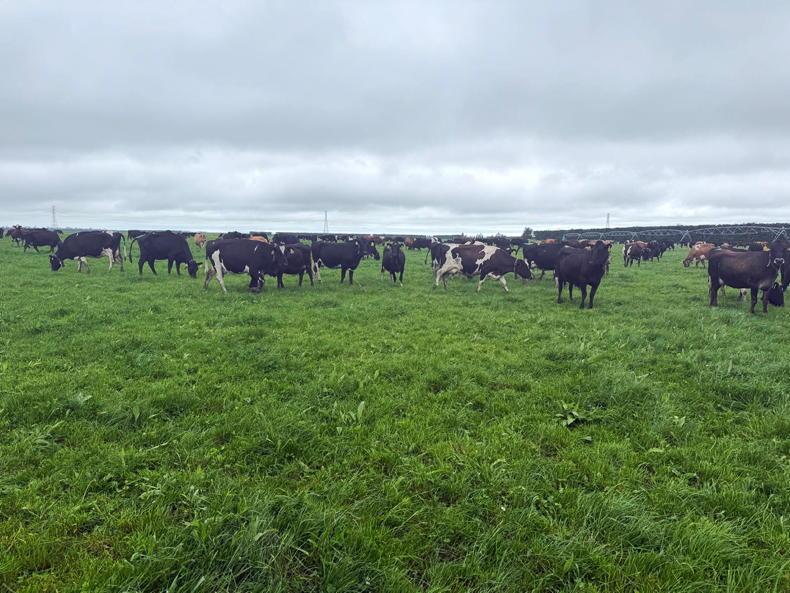
The cows are a crossbred herd with good genetics and a six-week calving rate around 90%.
Off-winter grazing, such as fodder beet and kale, is counted as imported feed, so the majority of farms operate somewhere between system 2 and system 5, as New Zealand farms on the South Island typically winter their cows on blocks away from the milking platform.
The milking cows’ diet consists of grass, maize silage and about 1,300kg of palm kernel per cow, which is typically fed in the shoulders of the year.
Will is very clear that the system only works if they keep grass as the most important part of the jigsaw. Growing and utilising as much grass as possible is the business’s first focus.
Stocking rates are set very high at 4 to 4.3 cows/ha to utilise every kilo of grass that grows during the peak growing months. Imported feed is then used as a top-up the diet particularly in the shoulders of the year when growth is below demand.
Essentially, the Graylings are building their system around matching demand exactly to peak grass growth for about four months of the year, from late spring to early autumn.
The farms are irrigated, meaning they can guarantee growth rates of around 70kg to 75kg DM/ha/day for the entire summer. At a stocking rate of 4 cows/ha, that’s a grass allocation of over 17kg/cow/day.
The irrigation acts as an insurance policy, as it allows them to carry the risk of higher stocking rates.
In 2025, the farms utilised 16t DM/ha, with 185kg N/ha applied across the year.
The milk output per hectare is consistently around 2,000kg of milk solids/ha at 480kg MS/cow.
Good fertility and a tight six-week calving rate are also crucial factors in achieving this performance.
The herd is very much crossbred, with mature cow weights around 480kg. The farms are operating at around a 90% six-week calving rate, with empty rates running at around 10% to 12%.
Management
The enormous scale of the business means a huge number of staff. The management of the farms is complex, as high stocking rates and a lot of imported feed mean a lot of daily decisions.
Will can’t be responsible for all of these decisions, as it’s just not feasible. Therefore, he relies on the people in the business taking responsibility and learning from mistakes.
“There’s going to be mistakes. I make them, the team makes them, everyone. The way we look at it, everyone is going to make at least one wrong decision each week. On this farm, that’s 12 mistakes a week, which is nearly two per day.”
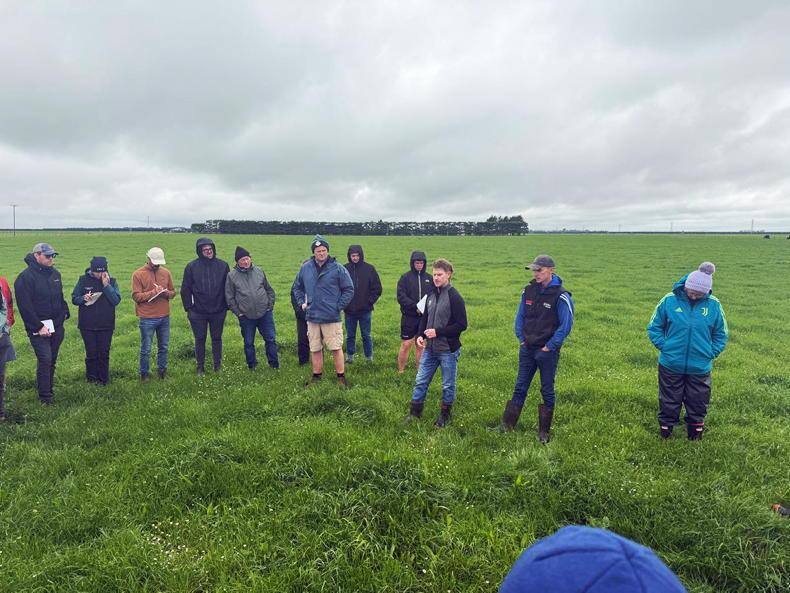
Will speaking to Irish farmers who visited the farm.
“It’s my job to educate them the best I can when they arrive and keep that number of mistakes to twelve. You can’t be a nitpicker on big farms like this,” Will says.
The Graylings are renowned for their people management and regularly have students and other employees queuing up at the door to work for them. They currently have four Irish students working on the farm who all spoke very highly of the couple and their business.
One would imagine that training this number of staff would be very challenging, but Will has a simple approach to it.
New recruits to the team start off by learning how to measure grass, spot what a good pre-grazing yield looks like and identify what a residual needs to be.
“After that, it’s just showing them the things that could hurt them and making sure they don’t do that,” he says light-heartedly.
Profitability
System 5 farms that are run well, with a good handle on costs, are likely to perform well in a high milk price year. This is exactly what the Graylings are benefiting from at the moment.
Fonterra has paid record milk prices for two years in a row and is set to pay a new record for the current season.
With a farm producing 2,000kg/ha of milk solids at a milk price equivalent of €5.20/kg MS, while also keeping farm working expenses to the equivalent of €2.75/kg MS, returns are excellent.
Farm working expenses do not include capital expenditure, personal drawings, taxes, debt repayments or interest, and therefore the actual total costs will be closer to €3.80/kg MS. Even so, the farm is highly profitable and generating a lot of cash.
The Graylings’ story is a great one. Anyone who was lucky enough to see Will Grayling speak at the 2017 Positive Farmers Conference will remember the enthusiasm and charisma he displayed on the day. He’s very much still the same character today.
The business he and Kim have put together is extraordinary, but it’s their clarity on the principles and KPIs for the business that is truly impressive.
Grass is everything to them: growing enough of it, grazing it at the right time and making sure it’s grazed well. The rest of the system falls into place around those pillars.
They are the blueprint for how a higher-input system can work. Grow a lot of grass, utilise it really well and maintain very strict control on costs.
You also need to be an exceptional manager of people and technical farm detail, as there are significantly more moving parts and more opportunities for mistakes to be made on a daily basis. Will was the first to admit this.