

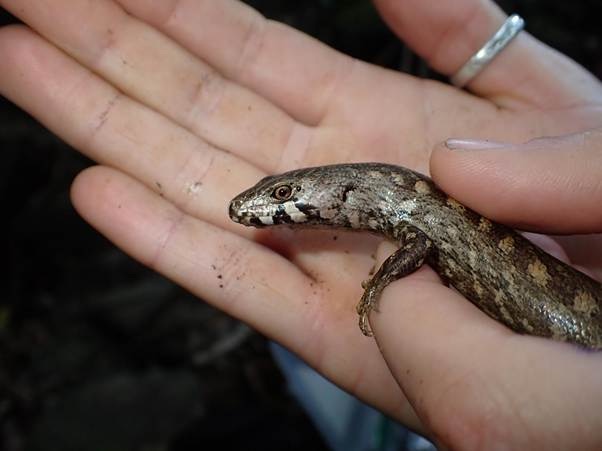
Skinks, or Niho taniwha, are an endangered native species.
Photo/Supplied.
In
Brief:
- MIT and Unitec Master
of Applied Science ākonga ‘learners’, Meesha Anderson
and Sophie Whittall, are investigating the health, behaviour
and habitat use of endangered chevron skinks as part of a
collaborative translocation project on Aotea Great Barrier
Island. - Working under the
supervision of Associate Professor Marleen Baling, and
alongside Auckland Zoo, local iwi, Department of
Conservation and conservation partners, Meesha and Sophie
are contributing research to support the future management
of this culturally significant taonga
species. - The translocation
project is being filmed for the TV show Wild Heroes, a
wildlife documentary series featuring Auckland Zoo and
screened on local and international
networks.
MIT and Unitec ākonga
will join Assoc Prof Baling for the second translocation of
captive-bred Chevron skinks, or niho taniwha, to
Glenfern Sanctuary on 5 November.
Their research will
help us understand how the rare reptiles adapt and establish
themselves after release.
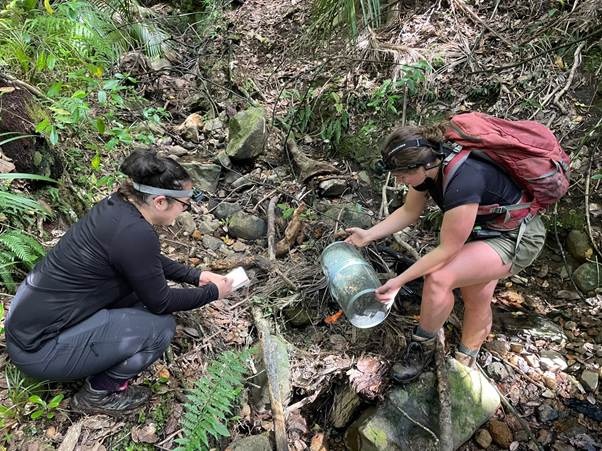
of Applied Science ākonga ‘learners’, Meesha Anderson
and Sophie Whittall.
Photo/Supplied.
Advertisement – scroll to continue reading
Working alongside
Auckland Zoo, Ngāti Rehua-Ngātiwai ki Aotea Trust, the
Department of Conservation (DOC), Glenfern Sanctuary Trust
and Auckland Council, our ākonga are gaining hands-on
experience in applied conservation science while producing
research that could directly inform the future management of
the species.
This project brings together ecological
research, animal health monitoring and mātauranga Māori,
recognising both the biological importance of the skinks and
their cultural significance.
“Chevron skinks are
only found on two islands in the world: Aotea Great Barrier
Island, and Hauturu-o-toi (Little Barrier Island),” says
Assoc Prof Baling, the students’ thesis
supervisor.
“This translocation is the first for the
species and is also culturally significant as it’s a return
of these animals to their home.”
The release at
Glenfern Sanctuary, an Auckland Council-managed site, will
supplement an existing chevron skink population, with the
research helping determine whether the translocated animals
successfully establish themselves in their new
environment.
Meesha and Sophie are investigating
different but complementary aspects of the skinks’ health
and behaviour, building an evidence base that could support
future conservation decisions.
Meesha’s research
focuses on the gut microbiome — the community of
microorganisms living in an animal’s digestive system —
and how it may relate to health and adaptation following
release.
Cloacal swab samples will be collected from
captive skinks before their release, as well as from
resident and translocated skinks encountered during
post-release monitoring.
Her research will investigate
differences between captive and wild skinks and whether
microbiome diversity changes over time.
“Her
(Meesha) project will provide foundational information on
whether the gut microbiome in NZ lizards can change over
time or is set early in stage in life,” says Assoc Prof
Baling.
“This has implications for species
management, especially in captive environments, and for
future decisions about selecting animals or populations for
translocations.”
Sophie’s research, undertaken in
collaboration with Jo Monks at the University of Otago, will
investigate how the released skinks move through and use
their new habitat.
The animals will be fitted with
tiny radio-transmitters weighing less than half a gram, then
track newly released and resident skinks daily for up to a
month.
By recording their locations, movements, refuge
sites, surrounding vegetation, temperature and humidity,
Sophie will build a picture of how the animals settle into
Glenfern Sanctuary.
“Niho taniwha are super
camouflaged and cryptic, so it’s like finding a needle in a
haystack,” Sophie says.
“Even with a radio
transmitter attached, it can be tricky!”
The work
can take her through steep gullies, along waterways, into
large debris dams and up trees following the transmitter
signals.
Her research will compare the movements and
habitat use of translocated and resident skinks, while
examining whether seasonal differences influence their
behaviour and the success of the releases.
Over time,
the findings will also contribute to a catalogue of known
individuals at Glenfern Sanctuary, supporting ongoing
monitoring of the population, including changes in growth
and body condition.
The project provides first-hand
experience for our ākonga on how conservation science works
in practice, bringing together technical expertise,
community relationships and cultural
responsibilities.
Sophie describes being involved as
“an incredible privilege”, particularly given the
ecological and cultural significance of returning the skinks
to the island.
“You could feel the emotion and
connection behind the kaupapa,” she says, reflecting on
the pōwhiri for the previous niho taniwha
translocation.
“I’m grateful to build on the hard
work of everyone involved, while helping to gather
information that can support future conservation
efforts.”
Meesha says the project has highlighted
the importance of collaboration between scientific
organisations and mana whenua, and the value of
incorporating Māori perspectives into research.
“As
a Māori student, it is important to me that Māori values
are included in the way I conduct science and finding
different ways to consider traditional ecological knowledge
when I am studying, researching or doing a project of this
magnitude,” she says.
Seeing the opportunity to work
alongside local iwi as integral to understanding what niho
taniwha mean to the iwi and how the return of the species
may affect both the community and the animals.
“This
work feels important not only as we aim to add to the
biological repertoire of a native species, but getting the
privilege of working alongside Ngāti Rehua-Ngātiwai ki
Aotea to better understand what Niho Taniwha are to them and
how this return will impact iwi and the
species.”
The project is also supported by Glenfern
Sanctuary Trust, which provides accommodation, local
knowledge, equipment and practical assistance in the
field.
Assoc Prof Baling says these partnerships are
essential to the project’s success, helping ensure the
research addresses the conservation priorities of the
organisations and communities involved.
“These types
of postgraduate projects are very valuable for students to
be directly involved in, as the results of their project
will be directly applicable to the conservation management
of the species,” Assoc Prof Baling says.
“The
information that the students collect will feed back to the
future monitoring and management of the species onsite,
potentially modifying any future captive husbandry
management and also future translocation of chevron
skinks.”
Sophie says that combination of research
and practical conservation is precisely what makes the
experience valuable.
“I love combining research with
hands-on conservation mahi, while working toward important
outcomes for a species as special as niho taniwha,” she
remarks.
“I’ve also made some awesome connections
through the project and am gaining exactly the kind of
experience I hoped to from my Master’s.”
The
upcoming translocation will also be filmed by Magnetic
Pictures for the TV3 show Wild Heroes, a wildlife
documentary series featuring Auckland Zoo and screened on
local and international networks.
Associate Professor
Baling’s earlier chevron skink research was featured in the
series (watch the episode here
–
https://www.threenow.co.nz/shows/wild-heroes/S4073-776),
helping make reptile conservation research more accessible
to the public.
Her involvement with the species
stretches back to her own master’s research at the
University of Auckland in the early 2000s — bringing her
work full circle, now supervising postgraduate students
contributing to its
conservation.
Source link