

Researchers from the Skoltech AI Center, together with
colleagues from the Zelinsky Institute of Organic Chemistry
of the Russian Academy of Sciences, ITMO University and
other institutions, have prepared a
review, which appeared in Chemical Society Reviews, one of
the leading international review journals in chemistry,
published by the UK-based Royal Society of Chemistry. The
authors examine where AI produces measurable value in a
chemical research workflow, how to assess its reliability,
and why a strong benchmark result does not necessarily
translate into laboratory performance.
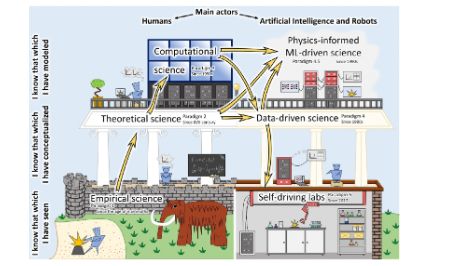
1. The evolution of chemical research, from empirical
observations to self-driving laboratories. Artwork by Anton
V. Leonov (Zelinsky Institute) from the review. © Royal
Society of Chemistry,
2026.
Chemical research produces
diverse information: scientific publications, images,
spectra, measurements, and reaction records. Understanding
the relationship between molecular structure and properties
remains essential. Researchers also make a sequence of
practical decisions: which evidence to examine, which
experiment to run next, and how to adjust the plan after a
new result. The review uses this decision sequence as its
organizing framework.
Advertisement – scroll to continue reading
The authors divide chemical
research into stages that generate, transform, and validate
information, and map AI methods onto each stage. They
discuss classical machine learning, models that incorporate
chemical knowledge, and emerging foundation models for
chemistry. Their emphasis is on measurable outcomes and
recurring failure modes, rather than benchmark scores
alone.
The review covers knowledge extraction from the
scientific literature and accumulated datasets;
interpretation of experimental data from spectroscopy, mass
spectrometry, and microscopy; prediction of properties and
reactivity; synthesis planning; and systems in which the
outcome of one experiment guides the next. Representative
applications illustrate what can transfer to a new problem
and where a method’s limitations matter.
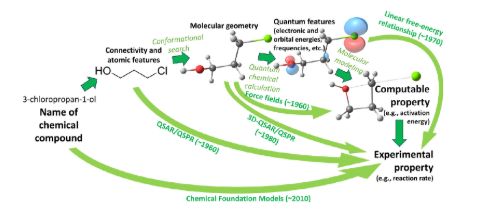
2. From a compound’s name and structure to a prediction of
its experimental property: alternative modeling routes.
Image by Michael Medvedev (Zelinsky Institute) from the
review. © Royal Society of Chemistry,
2026.
In their conclusion, the
authors identify three ways AI can change a chemist’s work.
It can extract mechanistic insight from complex spectra,
images, and scientific texts; identify promising compounds,
synthesis routes, and experimental conditions from among
many options; and connect predictions to automated
experiments whose results guide the next step. Figure 2 uses
property prediction to show which steps between a molecular
description and an experiment different models can perform.
AI’s practical value depends on whether it improves
decisions under real research constraints.
“We
wanted to look at AI from the perspective of a chemist who
needs to make research decisions. A model’s high accuracy
on test data is only the tip of the iceberg. What matters
more is whether it helps interpret measurements, plan
informative experiments, and maintain the quality and
reliability of its predictions when working with new
compounds and reactions,” says Alexander Ryabov, Senior
Research Scientist at the Skoltech AI Center.
The
authors examine risks that can inflate the apparent success
of a model: information leakage between training and
evaluation, overfitting to a limited set of examples, and
extrapolation errors beyond familiar data. These issues are
especially consequential in chemistry, where substances,
reaction conditions, and instruments vary, while
experimental validation takes time and resources. Before
using a model, the authors advise checking whether its
training data match the compounds and instruments of a
particular laboratory, how reliably it estimates prediction
uncertainty, and whether it has been tested on new
experiments whose results were not known during
training.
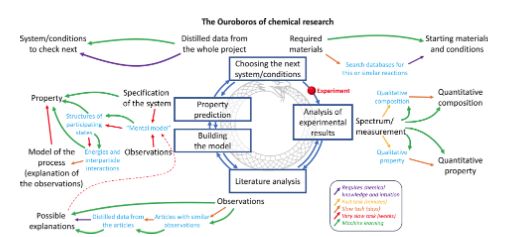
3. The Ouroboros of chemical research: data and results flow
between tasks, and green arrows show where AI methods can be
applied. Image by Michael Medvedev (Zelinsky Institute) from
the review. © Royal Society of Chemistry,
2026.
“The next stage of AI in
chemistry will bring together advanced large language models
(LLMs) and physics-informed models that respect chemical
constraints. An AI agent must assess when a physics-informed
model’s prediction is well founded, when it goes beyond
the data used to train it, and which experiment would best
reduce uncertainty. The researcher, in turn, remains
responsible for defining the scientific question and
verifying the results produced by the AI agent,” says
Michael G. Medvedev, Head of the Theoretical Chemistry Group
at the Zelinsky Institute of Organic Chemistry and first
author of the review.
Skoltech AI Center co-authors
include Alexander Ryabov, Senior Research Scientist;
Vladimir Vanovskiy, Head of Hybrid Modeling; and RAS
Professor Evgeny Burnaev, Director of the AI Center and
Skoltech Vice President for AI Development. Zelinsky
Institute co-authors include Michael Medvedev, Head of the
Theoretical Chemistry Group, and RAS Academician Valentine
Ananikov. Evgeny Burnaev, Michael Medvedev and Valentine
Ananikov are Sber Science Prize laureates. Looking ahead,
the authors argue that chemistry-grounded foundation models
and intelligent experimental platforms should be evaluated
across full research cycles, from the initial question to a
reproducible result.
Skoltech:
Skoltech is a
private international university (part of the VEB.RF group)
in Russia, cultivating a new generation of leaders in
technology, science, and business. As a factory of
technologies, it conducts research in breakthrough fields
and promotes technological innovation to solve critical
problems that face Russia and the world. Skoltech focuses on
six priority areas: life sciences, health, and agro;
telecommunications, photonics, and quantum technologies;
artificial intelligence; advanced materials and engineering;
energy efficiency and the energy transition; and advanced
studies. Established in 2011 in collaboration with the
Massachusetts Institute of Technology (MIT), Skoltech was
listed among the world’s top 100 young universities by the
Nature Index in its both editions (2019, 2021). On
Research.com, the Institute ranks as Russian university No.
2 overall and No. 1 for genetics. In the recent SCImago
Institutions Rankings, Skoltech placed first nationwide for
computer
science.