


Nic
Rawlence, University
of Otago and Alexander
Verry, University
of Otago
The last bird to go extinct
in Aotearoa New Zealand was a tiny wren that disappeared
from a small island off the southern tip of Rakiura Stewart
Island around 1972.
Stead’s
bush wren, or mātuhituhi, was the last of its kind. The
North
and South Island bush wrens had already gone extinct by
1955 and 1968, respectively. Stead’s bush wren followed
after ship rats invaded its last stronghold on Taukihepa Big
South Cape Island.
This incursion also caused the
extinction of the tutukiwi Stewart
Island snipe and greater
short-tailed bat, as well as the near-extinction of the
South
Island tīeke saddleback.

specialists.
Paul
Martinson/Te Papa Tongarewa Museum of New Zealand, CC
BY-NC-ND
Advertisement – scroll to continue reading
The rats were likely introduced accidentally
from fishing boats around 1963 and exterminated the wrens
rapidly within a few years. Six birds were moved to nearby
Kaimohu Island in 1964, but despite the best efforts to save
them, the last two individuals were seen in
1972.
The extinction of Stead’s bush wren shows
how vulnerable
small ground-dwelling birds are. But scientists know
surprisingly little
about them.
Now, our new
study based on ancient DNA reveals the evolutionary and
ecological history of these lost birds as well as a
previously unrecognised member of the bush wren
family.
Deep and dynamic evolutionary
history
Bush wrens (Xenicus longipes)
were once widespread across New Zealand, with different
subspecies on the North, South and Stewart Island. The
historical and fossil record shows they were a forest
specialist with limited dispersal ability.
Bush
wrens belong to New Zealand’s unique wren family
(acanthisittidae) that also includes the living pīwauwau rock
wren and tītipounamu rifleman
as well as four other recently
extinct species.
New Zealand wrens are
representatives of an ancient lineage which diverged from
all other song birds (passerines) about 70
million years ago.
Our analysis
of ancient DNA from specimens held in museum collections
worldwide shows bush wrens evolved about six million years
ago when the uplift of the Southern Alps created a variety
of new habitats.
The North (Xenicus
stokesii) and South Island (Xenicus longipes)
bush wren diverged about 2.6 million years ago. Back then,
the southern end of the North Island was connected to the
South Island and as marine straits in the Manawatu region
narrowed, bush wrens could island hop from south to north.
Our analyses strongly suggest they should be recognised as
distinct species rather than subspecies.
South
Island bush wrens remained stable until about 500,000 years
ago when we identified a near simultaneous, major
diversification event that split them into northern, central
and southern lineages. Stead’s bush wren emerged about
94,000 years ago.
A new member of the bush wren
family
The key to disentangling the evolutionary
history of bush wrens was our ability to use ancient DNA to
genetically
sex specimens and to re-examine the plumage of male and
female museum specimens. Prior to this, scientists were
convinced there were no
plumage differences between the sexes.
We found
that different bush wren lineages do in fact show marked
plumage differences between sexes, with the exception of the
South Island bush wren from Fiordland, where males and
females both had green plumage.
When we put all the
genetic and plumage data together, we found a new bush wren
hiding in plain sight within the central and northern South
Island. It was different to all the other recognised bush
wrens.
We named this new subspecies the Tōtaranui
bush wren (Xenicus longipes perditus) after the
Māori name for Queen Charlotte Sound. In its Latin name,
perditus stands for lost.
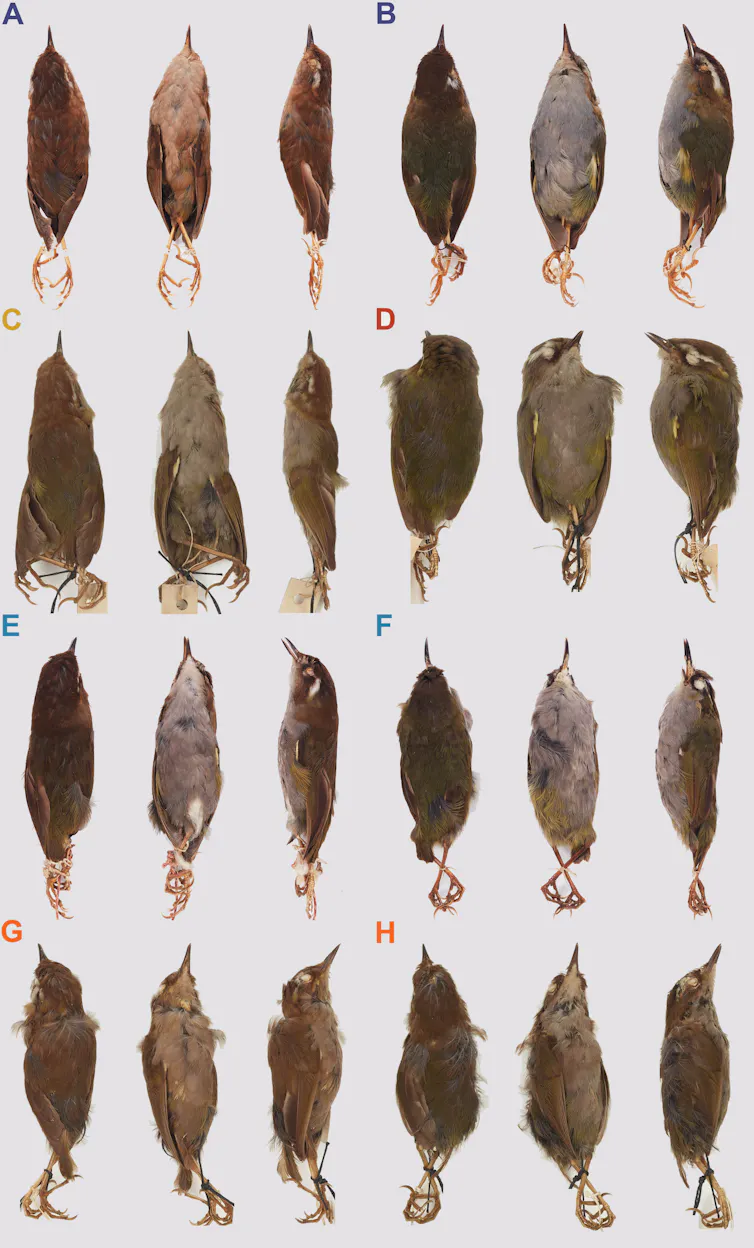
sexing was key to unravelling the highly variable plumage of
bush wrens. These museum specimens show North Island bush
wren juvenile (A) and male (B); Tōtaranui bush wren female
(C) and male (D); Fiordland bush wren female (E) and male
(F) and Stead’s bush wren female (G) and male
(H).
Jean-Claude
Stahl/Te Papa, CC
BY-NC-ND
Ice Age climate change
What caused
this near simultaneous burst of diversification in bush
wrens?
Some 2.58 million years ago, the world
entered an Ice
Age and cycled through 19 to 20 shifts between cold
glacial and warm interglacial periods. Forests and the
animals that lived in them retreated
into separate areas during cold periods and expanded across
the South Island when it warmed.
Initially,
these cycles were relatively mild, lasting around 40,000
years. However, when Earth’s wobble on its axis shifted
around one millions years ago, these cycles intensified and
extended, lasting about 100,000 years.
While
bush wrens could buffer climatic changes to an extent, they
eventually reached a tipping point and retreated
to multiple different refugia. Their diversification is
a prime example of glacier-driven
evolution.
The extinction of the Stead’s
bush wren marked a turning
point for New Zealand conservation and the management of
rodents on islands. Yet bush wrens continue to provide
lessons for future ecosystem restoration and
conservation management, especially for species with strict
habitat requirements.
Accelerating human-driven
environmental impacts and climate change will put ecosystems
under increased pressure and exacerbate the impacts of
invasive species and habitat modification.
It is
imperative we do what we can now to preserve genetic
diversity within threatened species and increase the climate
resilience of ecosystems before it is too late.
Nic
Rawlence, Associate Professor in Ancient DNA, University
of Otago and Alexander
Verry, Researcher, Department of Zoology, University
of Otago
This article is
republished from The
Conversation under a Creative Commons license. Read the
original
article.