


/ Supplied
“Truckloads of bad news
have piled up for scientists this month, and we’re not
expecting any good news as Budget day approaches,” says
New Zealand Association of Scientists (NZAS) Co-President
Troy Baisden.
Co-President Lucy Stewart says, “The
government had been trying to create a rosy picture by
pointing to private sector Research and Development
(R&D). But data into 2025 in StatsNZ’s latest survey
shows that business spending on R&D has flatlined and
employment in R&D has dropped 5 – 10% in a single
year. This shows a big loss of confidence in investing in
R&D, and will almost certainly be worse when the survey
data into 2026 becomes available.”
Baisden adds,
“For those in research institutions dependent on
government funding, applicants to the Marsden fund will be
staring in shock at letters received last week saying that
84% of applicants didn’t make it past the first round.
That means less than one in twelve applications will be
funded after the final round. That’s a big drop which
suggests we’ve crossed into the realm where, on average,
researchers and institutions will be spending as much or
more on applying than comes back in
funding.”
“That’s bad enough for senior
researchers, but the smaller Fast Start grants designed to
support early career researchers, the success rate through
to the final round has tanked from 24% to 17%, also implying
only 8% will be funded.”
Advertisement – scroll to continue reading
Stewart points out,
“Scientists are losing hope as these lacklustre reforms
show little understanding of the long-term effects of the
changes being made. A clear pathway for reform was offered
by the Science System Advisory Group, but the cherry-picking
continues. The strategy behind the reforms remains
unclear.”
Baisden says, “We’re particularly
worried that the development of Research Funding New Zealand
will not simplify the system as intended. Instead, it will
take shortcuts, with a structure that enables ministers and
the ministry to arrive at their desired outcomes more
quickly and cheaply, while fencing inconvenient truths
outside of funding. Shortcuts are a mistake, and we’re
heading toward losing both the expertise and independence
needed to administrate public science
investment.
“This week, Pillar Advisory Groups have
been named – with some great people and experience
included. But these bodies contain at least 80% insiders,
including many Chief Science Advisors (CSA) from Ministries
and Departments plus commercial leaders. Historically the
CSA roles have focussed on providing trusted advice, while
avoiding conflicts of interests associated with also
controlling funding. At the same time, areas that really
matter to our nation, like biodiversity and geological
hazards, are represented by a single person out of
35.
Moreover, on Thursday we saw a highly confusing
announcement about science funding being moved into a
Transition Research Fund. The size of the fund initially
announced made it look like it was a quarter of the size of
the funds it replaces. We’ve been assured that’s not
intended to be the case, but will be chasing the numbers.
Updates to web pages still imply there will be significant
cuts.”
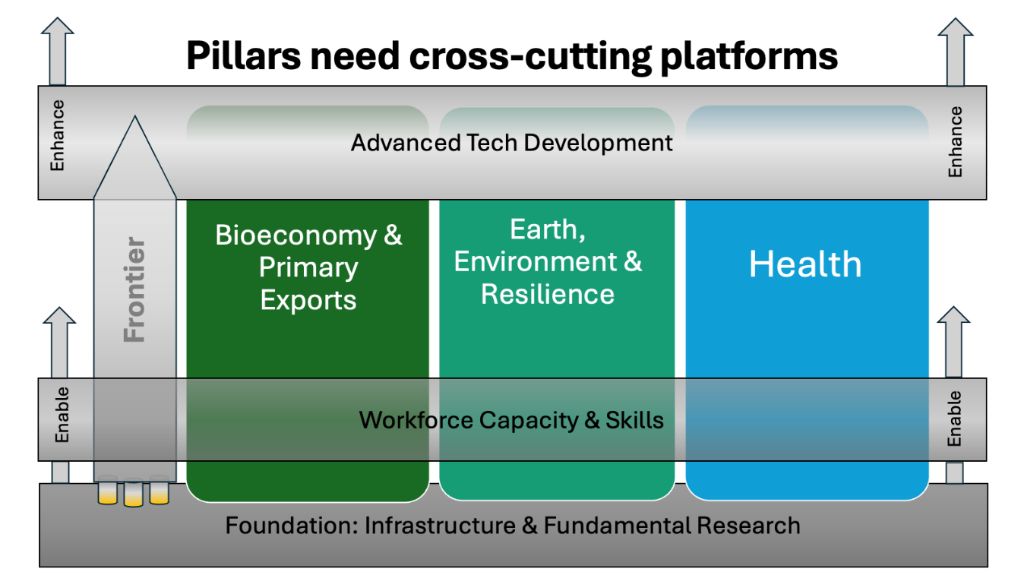
Stewart points out, “In light of these
issues, we’ve taken the step of providing a Briefing to
the Incoming Minister (BIM), which clarifies how key
themes in the reform can be improved. It begins justifying a
better science system and investment, and ends with four
narrative strategies that define success. Our graphic
provides a much better sense of the focal points that must
be created between horizontal layers and vertical pillars
representing our existing strengths. It emphasises the
importance of the foundations and workforce we’re
neglecting and the need for agility in new
areas.”
“We need structures and investment that
will keep us safe and healthy while enabling our economy to
perform like peer nations. Further cuts, shortcuts and
uncertainty will cause lasting damage.”
1] https://www.stats.govt.nz/information-releases/research-and-development-survey-2025/
2]
https://www.royalsociety.org.nz/news/marsden-fund-preliminary-proposals-for-2026
3]
https://www.mbie.govt.nz/science-and-technology/science-and-innovation/funding-information-and-opportunities/investment-funds/transition-research-fund-2027
For comparison, after recent cuts the combination of
Marsden, Endeavour and Talent Funding is currently $341m per
annum.