


Te Whare Wānanga o Waitaha | University of Canterbury
(UC) Faculty of Engineering Associate
Professor Sarah Kessans and her team have developed a
fully automated, high-throughput platform that could reduce
work traditionally carried out by astronauts aboard space
stations. This will allow researchers to screen thousands of
crystallisation conditions in orbit.
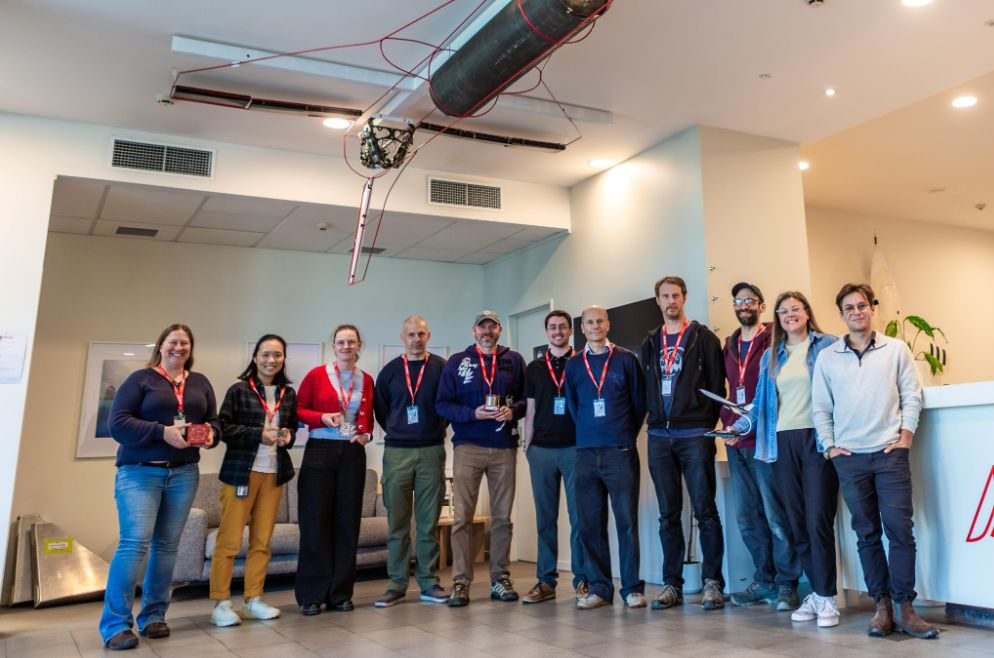
of the UC-led Kiwi Space Activator team with prototypes of
research hardware that will be tested during the spaceplane
flight campaign. L to R: Sarah Kessans (UC Project Lead),
Yiling Sun (UC Postdoc), Olivia Sun (UC Postdoc), Alek Lazik
(Intranel), Dave Sanders (Intranel), Kieran Williams
(Asteria), Felix Collins (Intranel), Peter Dunlop
(Intranel), Josh Schoolcraft (Intranel), Julia Sothmann
(Dawn), and Zach Preston (Dawn)
(Photo/Supplied)
Advertisement – scroll to continue reading
“We’ve
essentially shrunk an entire crystallisation lab into a
shoebox-sized platform,” says Associate Professor
Kessans.
“That means we can do far more testing than
has traditionally been possible in orbit, while dramatically
reducing the need for astronauts to manually carry out
experiments.”
The technology focuses on protein
crystallisation; a process used in drug discovery and
pharmaceutical formulation research.
“In
microgravity, you get much bigger, much higher quality, more
perfect protein crystals,” says Associate Professor
Kessans. “If we can get better crystals, we can get better
protein structures and design and develop better
drugs.”
Working alongside project partners Dawn
Aerospace, Intranel, and Asteria Engineering, the next phase
of the research will test components of the platform aboard
Dawn Aerospace’s reusable, unmanned
spaceplane.
Designed to launch from a runway, fly up
to 100 km altitude and return to Earth in a single flight,
the suborbital spaceplane creates short periods of
microgravity for experiments.
Expected to take place
through Dawn Aerospace’s operations at Tāwhaki National
Aerospace Centre in Canterbury, the flights will allow
researchers to test and rapidly iterate systems before
future missions to commercial space stations. Alongside
testing subsystems during the test flight campaign, the team
will conduct a range of protein crystallisation experiments
to demonstrate the value of short-duration microgravity
research.
“We will be the first mission of its kind,
conducting multiple spaceplane microgravity flights and
going to space twice in a single day,” says Associate
Professor Kessans.
She says the project reflects New
Zealand’s strength in aerospace and biotechnology
innovation.
“We’re willing to take risks on
ambitious projects and work together across disciplines in
ways that enable really exciting research,” she
says.
“I wouldn’t be able to do this work without
the incredible community of researchers, engineers, and
companies we have here in New Zealand.”
The research
builds on work already supported through a UC-led $10
million MBIE Endeavour Fund Research Programme, including a
prototype platform launched to the International Space
Station in 2024.
The latest phase of the project has
received $600,000 through the Kiwi Space Activator
programme, announced last Friday by Minister for Space Hon
Chris Penk.
Associate Professor Kessans says the
funding enables the team to begin this next phase of testing
with Dawn Aerospace.
“I’m an absolute science
geek, so I’m really excited to see what the possibilities
are from a science perspective.”
Read the Kiwi Space
Activator funding announcement here:
https://www.beehive.govt.nz/release/first-kiwi-space-activators-announced