


Fly Derwent and New Zealand marine innovator Vessev today announced
plans to launch Australia’s first electric hydrofoiling
network on Tasmania’s Derwent River, establishing a new
category of urban water transport.
The network will
launch with a VS–9, Vessev’s flagship 10-seater,
nine-metre, fully electric hydrofoiling catamaran, which
lifts above the water on carbon fibre foils. Multiple
VS–12s have also been reserved, each carrying 30
passengers, creating a transport network that requires no
large-scale infrastructure investment or
upgrades.
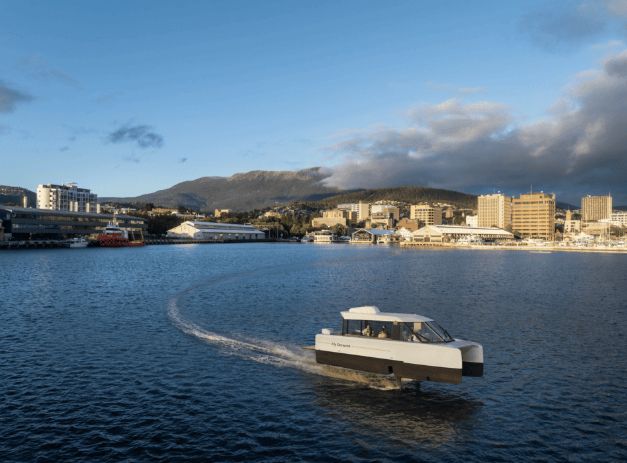
Fly
Derwent Principal Cameron McCulloch, a Hobart engineer with
nearly 20 years of executive experience in the clean energy
sector, said their vision is to transform river, lake, and
coastal transport in Tasmania.
“This world-leading
technology unlocks affordable, river-based commuter and
tourism transport in Hobart without the need for large-scale
infrastructure changes. That’s what excites me most –
not just the boats themselves, but everything they make
possible in Hobart and beyond.
“It’s an entirely
new mode of transport that enables us to use waterways in a
way that is more like a metro system than a ferry
service,” McCulloch said.
Vessev’s hydrofoiling
vessels cruise at around 25 knots and because they produce
virtually no wake while foiling, they can operate at higher
speeds without damaging the Derwent’s sensitive riverbanks,
a critical consideration for regulatory approval and
long-term environmental stewardship.
Advertisement – scroll to continue reading
“We explored more
conventional electric vessels, but they couldn’t solve the
core challenges of range, efficiency and wake in Tasmania’s
sensitive river environments. Hydrofoiling changes that
completely, lifting the hull clear of the water, reducing
drag and unlocking the efficiency needed to deliver
commercial services on electric power alone,” McCulloch
said.
Tasmania already operates at close to 100%
renewable electricity generation over a typical year,
powered predominantly by hydropower and complemented by wind
and solar. That same grid will charge the Fly Derwent fleet,
a literal expression of water powering
water.
“Tasmania has been ahead of the clean energy
curve since the late 1800s and remains at the forefront of
renewable energy today. This project demonstrates how that
advantage can translate into leadership in sustainable
transport, reducing environmental impact and operating
costs, while insulating the state from reliance on imported
diesel and the volatility of fossil fuels,” McCulloch
said.
Because hydrofoiling improves efficiency by up
to three times compared to conventional boats, the VS–9
only requires a modest amount of energy to fully charge,
comparable to a standard EV. McCulloch is also exploring
other charging solutions including on-site battery storage,
vehicle-to-grid integration, and mobile charging
infrastructure to support future routes.
The
announcement also represents the first order of Vessev’s
VS–12 globally, marking a significant step forward for
scalable electric hydrofoiling at a network
level.
Vessev CEO Eric Laakmann said what’s happening
in Tasmania is the beginning of a much larger shift in how
cities think about water mobility.
“Electric
hydrofoiling enables an entirely new category of water
transport. Tasmania is a standout environment to demonstrate
this at scale, where abundant renewable energy and strong
local ambition come together to show what zero-emissions
marine transport can look like in the real world,” Laakmann
said.
“With projects now underway in both Tasmania and
Perth, we’re seeing genuine momentum build in Australia.
Almost every major city has waterways sitting largely unused
for passenger transport and electric hydrofoiling changes
that.”
The first stage of Fly Derwent will focus on
early commuter and premium tourism offerings, with plans to
reconnect Hobart’s thriving waterfront tourism hub. Based
out of the Hobart waterfront, the network will span the full
length of the Derwent River, servicing 60 kilometres from
New Norfolk to Opossum Bay.
Vessev and Fly Derwent are
working closely with relevant regulatory authorities to
ensure the service meets all requirements for this
innovative vessel type. Fly Derwent has strong local
partnerships and support across the region, which is
foundational to the project’s long-term success.
The
VS–9 is expected to arrive in Hobart in early 2027 and
Vessev is working closely with Fly Derwent to accelerate
deployment of the VS–12.
About Vessev
Vessev
sits at the intersection of boatbuilding and applied
technology, designing and building electric hydrofoiling
vessels in Auckland, New Zealand. The company develops its
vessels end-to-end – from hulls and foils through to
propulsion and control systems – keeping everything
tightly integrated. The team draws experience from the
America’s Cup, Rocket Lab, Apple and Tesla, combining
high-performance marine design with advanced electronics and
software. The result is an entirely new way to move on the
water that is better for people and the planet.
About
Fly Derwent
Fly Derwent is a Tasmanian clean energy
transport venture established by Cameron McCulloch. It is
the first in a series of projects aimed at unlocking
multi-sector and community benefits by applying technology,
renewable and sustainable solutions, and innovative
financing approaches to long-standing transport and
infrastructure challenges – rather than relying solely on
conventional thinking or traditional government
funding.
About the VS–9 and
VS–12
The Vessev VS–9 and VS–12 are
fully electric hydrofoiling passenger vessels providing
exceptional on-water experiences. Using carbon fibre foils
to lift the hull above the water, they significantly reduce
drag, deliver a smooth, silent ride, and greatly improve
energy efficiency, while producing zero on-board
emissions.
VS–9 key features:
- Capacity:
10 passengers - Top speed: 30 knots
- Cruise
speed: 25 knots - Range: Up to 50 nautical miles at
cruise speed - Charge rate: Up to 1.0 nautical miles
per minute - Propulsion: 100% battery
electric - Length: 8.95 m
- Beam: 3.1
m - Draft: 0.5 m-1.5 m
- Seakeeping foil: Up to
0.75 m
New Zealand’s largest ferry operator,
Fullers360, operates a VS–9, Manta, on
Auckland’s
Waitematā Harbour. Vessev has orders
across three continents and is scaling production to meet
global demand.
VS–12 key
features:
- Capacity: Up to 30
passengers - Propulsion: 100% battery
electric - Length: 11.5 m
- Beam: 5
m - Seakeeping foil: Over 1.0m
The VS–12
is currently in development. Fly Derwent has placed an order
for four VS–12s and will be the first in the world to
operate these next-generation
vessels.