



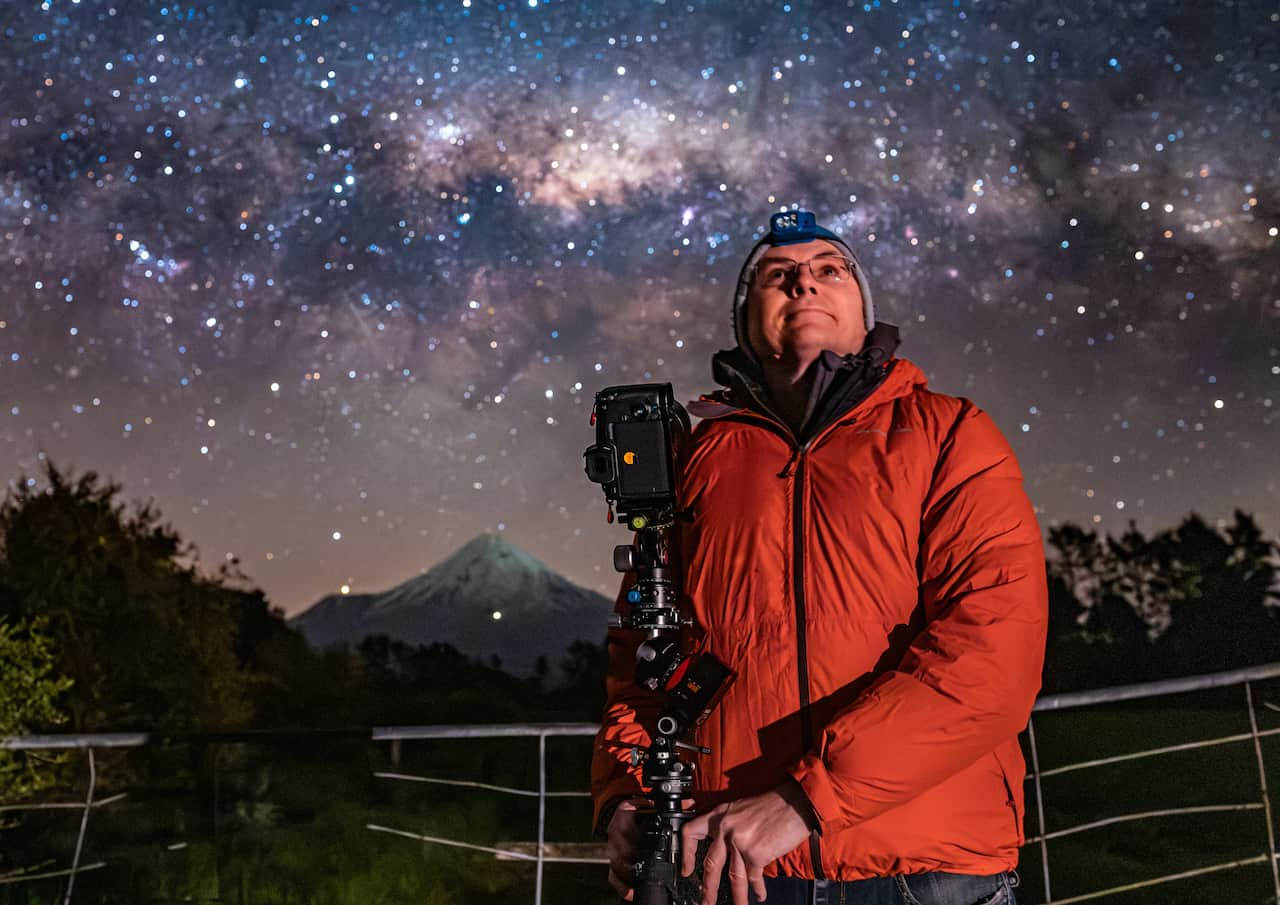
As a young boy scout, Brendan Larsen recalls admiring the stars in the Milky Way while on camps in New Zealand’s countryside. Now, a new object is illuminating the night sky — satellites.
Larsen, 51, has built a reputation as an astrophotographer, with his images of the vivid night sky collecting international prizes. But it was a photo he took of satellites, not stars, that recently went viral online.
“People are surprised and shocked and horrified at what has become of our night sky,” Larsen told SBS Dateline.
In September, he spent two hours capturing 578 photos of the night sky over Mount Taranaki on New Zealand’s North Island. He then spent 45 hours carefully editing the photographs together.
The final picture revealed around 1,400 satellites and 14,400 satellite trails streaking across the sky, according to Larsen’s calculations.
Your trusted source for staying up-to-date with the world around you. Get free daily news updates and analysis, straight to your inbox.
“People don’t actually realise how many satellites there are up there now. Even if you’re in the darkest location in the world, at a dark sky reserve or something like that, you can’t escape it anymore, these satellites.”
A dark sky nation?
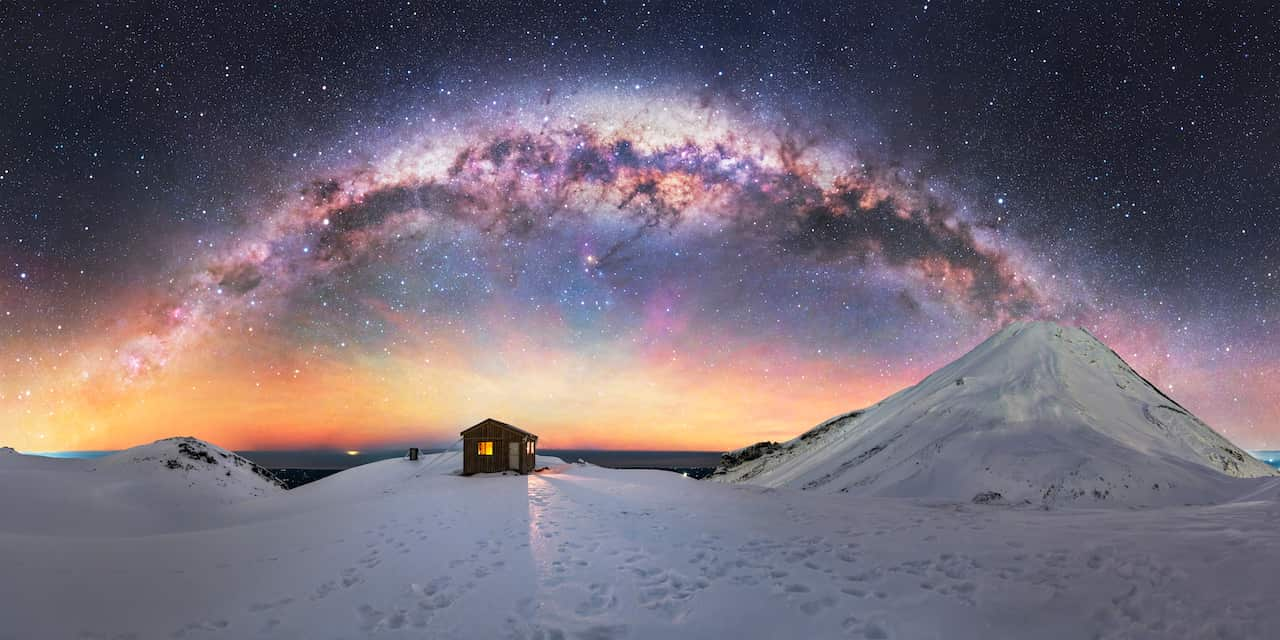
At a 2019 conference, a group of dark sky advocates and astronomers from across New Zealand announced an ambitious plan to certify the entire country as the world’s first dark sky nation, one that preserves and protects the night sky from light pollution such as inappropriate or excessive artificial outdoor lighting.
The country has 11 certified Dark Sky Places, according to Dark Sky Network NZ. That includes over 12,600 square kilometres of Fiordland National Park on New Zealand’s South Island, which was certified by US-based nonprofit DarkSky International this November.
Steve Butler leads the Royal Astronomical Society of New Zealand’s Dark Skies Group and has been involved in the nation’s dark sky movement for over three decades. He said he first became aware of the effects of artificial light pollution while visiting the Fiordland region in 1997.
“I was over in Fiordland as a parent helping on a school trip, and there was a major project going on, and the contractors had a big floodlight set up deep in the middle of a [wider UNESCO] World Heritage area,” Butler said.
“That floodlight was actually overpowering the glowworms along the sides of the tracks. So, the education officer who took the kids out apologised for the lack of glowworms glowing nicely … that was my first conscious thought that light at night had other impacts.”
Light pollution has also been found to affect the feeding patterns of nocturnal animals, disrupt turtle hatchlings from finding the ocean and disorient migratory and fledgling birds.
“When [some] young birds leave the nesting area to fly out to sea, they’re distracted by the lights of the nearby township and end up crashing and dying or getting injured,” Butler said.
Sky glow, or the brightening of the night sky, can reduce food availability by changing plant reproduction, flowering and fruiting. A growing body of research also suggests that excessive exposure to light at night can disturb human circadian rhythm and suppress melatonin production.
Butler said technological advances, including light– dimming systems, motion sensors and modified warm-temperature lighting could present new opportunities for individuals and communities to implement responsible lighting solutions.
But he believes advances in space technology could also present a new challenge.
New Zealand’s space sector
In February, New Zealand raised the number of rockets and satellites that could be launched into space from its territory from 100 to 1,000.
At the time of the announcement, New Zealand’s then space minister Judith Collins said: “When the limit of 100 was first set in 2017, New Zealand had very little launch activity. Since then, the landscape has transformed, to the point where we are the world’s third most frequent launcher of orbital rockets.”
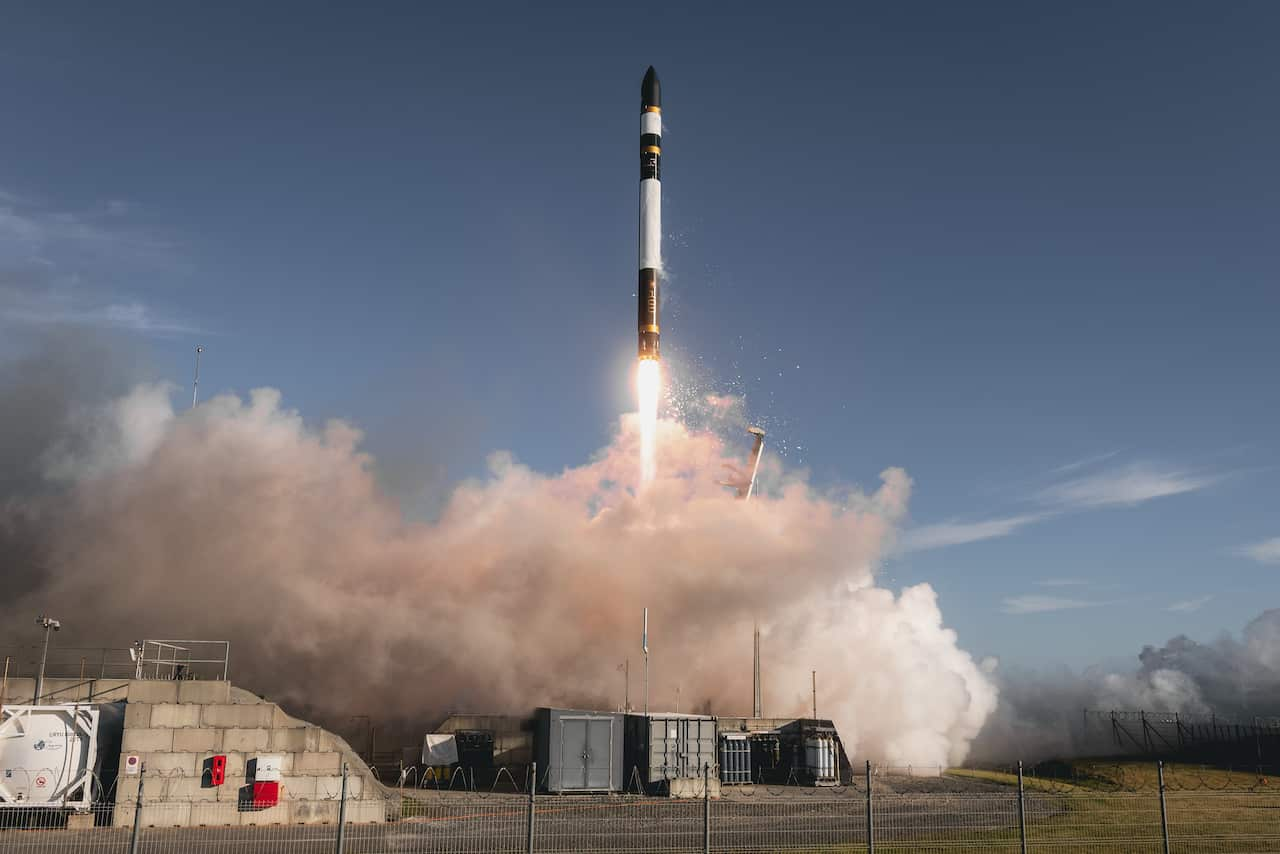
New Zealand’s space sector contributed NZ$2.47 billion ($2.03 billion) to the local economy in 2024. The country’s geographic position also makes it an attractive location for space and advanced aviation, offering unique launch trajectories and low air and sea traffic.
Shea Esterling is a senior lecturer at the University of Canterbury’s Faculty of Law and said New Zealand’s Space Agency forms part of the Ministry of Business, Innovation and Employment.
“I think that tells you the government’s understanding of what space is … it’s a resource to be used … it’s something to be commercialised, it’s an economic opportunity, it’s a growth opportunity.”
SBS Dateline has contacted New Zealand’s Ministry of Business for comment.
It referred SBS Dateline to the Ministry for Cities, Environment, Regions and Transport (MCERT), which said in a statement it considered the effects of launch debris deposition on the ocean and seabed while amending New Zealand’s space launch limits.
“This review did not investigate effects on light pollution from space vehicles … wider environment legislation that MCERT administers do not cover the light effects of space vehicles once they have launched or activities in orbit,” the statement read.
“The New Zealand Space Agency is responsible for regulating the space and high-altitude activities in New Zealand.”

According to Esterling, there are no explicit laws which protect dark skies in New Zealand or internationally.
“The ideal, gold standard would just simply be to flat out have some sort of treaty or mandatory regulations … about protecting dark skies,” Esterling said.
‘I missed the stars’
Butler admitted he is “not entirely sure” if New Zealand is on track to become a dark sky nation.
Currently, Niue, a small Pacific Island which is home to around 1,500 people, remains the only dark sky nation in the world. But Butler believes it’s clear that the “commercialisation of space has suddenly arrived”.
He is concerned about plans to launch mirrors into space which reflect and redirect sunlight to extend the output of solar farms and boost agriculture.
In January, Elon Musk’s company SpaceX also filed an application with the US Federal Communications Commission to launch up to one million satellites into space. SpaceX claimed the system would help power artificial intelligence and harness “near-constant solar power with little operating or maintenance costs”.
Esterling told SBS Dateline that it’s important to find a balance between “industry and development” and the protection of the “limited resource” of dark skies.
She said dark skies have long shaped the songs, stories, ceremonies and knowledge systems of Indigenous communities, including Māori people.
“It’s not just protecting sea turtles, which are adorable … [but] dark skies are actually a way to preserve knowledge, to preserve culture, to preserve heritage,” she said.
“Many cultures, the world over, throughout time have special connections with dark skies and rely on access to naked-eye observation and being able to see the stars.”
Astrophotographer Larsen believes it’s important that New Zealanders don’t take the clear night sky for granted. He lived in Japan for four years, including a stint in Tokyo, and said:
“At the time, I felt like I was missing something. In hindsight, one of the things I realised that I missed was the stars. You can hardly see any stars in Tokyo.”
While Larsen still holds hope that stars and the night sky will be protected, he believes the future remains uncertain.
“Twenty years from now, kids will be looking up at the night sky and asking their parents, ‘What’s that stationary dot in the sky that’s not moving?’ because all they can see is the crisscrossing of moving satellites.
“The parents will be like, ‘Oh, it’s a star. When I was a kid, it used to look incredible.'”
Source link