

Charitable trust boards will soon be required to confirm they are still operating, to ensure they can access funding, banking facilities and other essential services, the New Zealand Companies Office says.
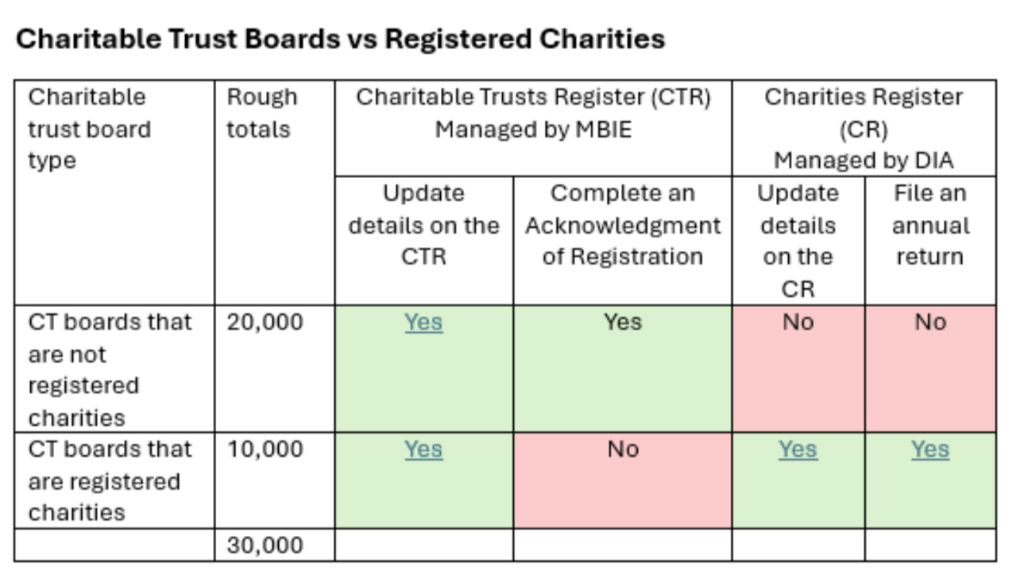
Approximately 20,000 charitable trust boards will need to complete an Acknowledgment of Registration (AoR) from April 2027 following changes made through the Regulatory Systems (Economic Development) Amendment Act 2025.
Companies Office National Manager, Bolen Ng, says the new requirement has been introduced to help maintain an accurate and reliable register while remaining straightforward for trust boards to complete.
“For most trust boards, it’s simply a matter of reviewing their details, updating anything that has changed, and confirming the information is correct,” says Mr Ng. “It’s a simple process that helps to ensure trusts boards can be contacted when needed and provides confidence that the information held on the register can be relied upon.”
The requirement was introduced through the Regulatory Systems (Economic Development) Amendment Act 2025 and will come into effect from April 2027. From that time, trust boards will be assigned a filing month and will receive reminders before and during that period. There is no fee to complete the annual acknowledgement.
Mr Ng says trust boards should start preparing for the change.
“The best thing trust boards can do right now is make sure their contact details are up to date. That will help to make sure they receive reminders, important updates and guidance about the new requirement,” he says.
Advertisement – scroll to continue reading
Trust boards email, postal and physical addresses should be current and regularly monitored as these contact details are used for official correspondence. They are not published on the public register.
The annual AoR will also help identify trust boards that are no longer operating, ensuring the Charitable Trusts Register remains a reliable source of information for trustees, organisations, funders, government agencies and the public.
Trust boards that do not complete their annual AoR may be removed from the register. However, Mr Ng says the Companies Office is focused on helping trusts comply.
“Our aim is to make this as easy as possible. We’ll be providing reminders, guidance and support throughout the process so trust boards can complete their AoR easily and confidently,” he says.
The new annual Acknowledgement of Registration requirement comes into effect from April 2027.
Charitable trust boards registered with Charities Services under the Charities Act 2005 are exempt from the AoR requirement and will continue to meet their existing reporting obligations through Charities Services.
Charitable trust boards can update their details at: Charitable Trusts
Note:
About the change:
The annual Acknowledgement of Registration requirement was introduced through the Regulatory Systems (Economic Development) Amendment Act 2025.
Annual acknowledgements will be completed during an allocated filing month, which will be assigned to each trust board. Once fully implemented, charitable trust boards are expected to complete an annual AoR each year.
The purpose of the requirement is to help maintain an accurate and reliable register by confirming that charitable trust boards are still operating and that their registration information, including contact details, remains current.
The requirement applies to charitable trust boards incorporated under the Charitable Trusts Act 1957 and registered with the Companies Office.
Charitable trust boards that are also registered with Charities Services under the Charities Act 2005 are exempt from the AoR requirement. They will continue to meet their existing reporting requirements through Charities Services – which is managed by Department of Internal Affairs (DIA). These entities are therefore exempt from the Acknowledgement of Registration requirement
For charitable trusts:
Check that your email address for communication is current and regularly monitored. Only a person authorised to do so by the trust, can access the trust’s details.
Make sure your addresses for communications are correct – email, postal and physical addresses.
Keeping your contact details up to date will help ensure you receive reminders and important notices.
These addresses are not published on the public register. They are used by the Companies Office to send official correspondence.
They should be addresses that are regularly monitored by your trust board. Email is the primary way the Companies Office will communicate with your trust board.